


1. Decide what you'll write down
Keep it to four kinds of moments: the good things you did, the things you're not proud of, the good things that happened to you, and the setbacks. That's enough to see a pattern without turning it into homework. If you like, add your mood, your health and one thing you're grateful for.
2. Write it down the same day
Memory fades fast, so note things on the day they happen. A short line is plenty: "helped a colleague finish a report" or "lost my keys again". Choose a time that suits you, such as after dinner, and let a reminder do the remembering.
3. Be honest, and kind to yourself
Tracking your karma only works if the not-so-good moments go in too. Nobody else will read them. The point isn't to judge yourself, it's to see your days clearly.
4. Look back every week and every month
Once a week, read back what you wrote. Once a month, look at the bigger picture: did your good deeds go up or down? Were there more lucky moments or more setbacks? How was your mood? Patterns usually appear after a few weeks.
5. Read patterns, not proof
Sometimes your luck will seem to follow your karma, and sometimes it won't. Either way, it's information about your own life, not a rule. Use it to reflect, not to predict.
Tracking your karma with Karma Trace
- Daily check-in: a few gentle questions at the times you choose.
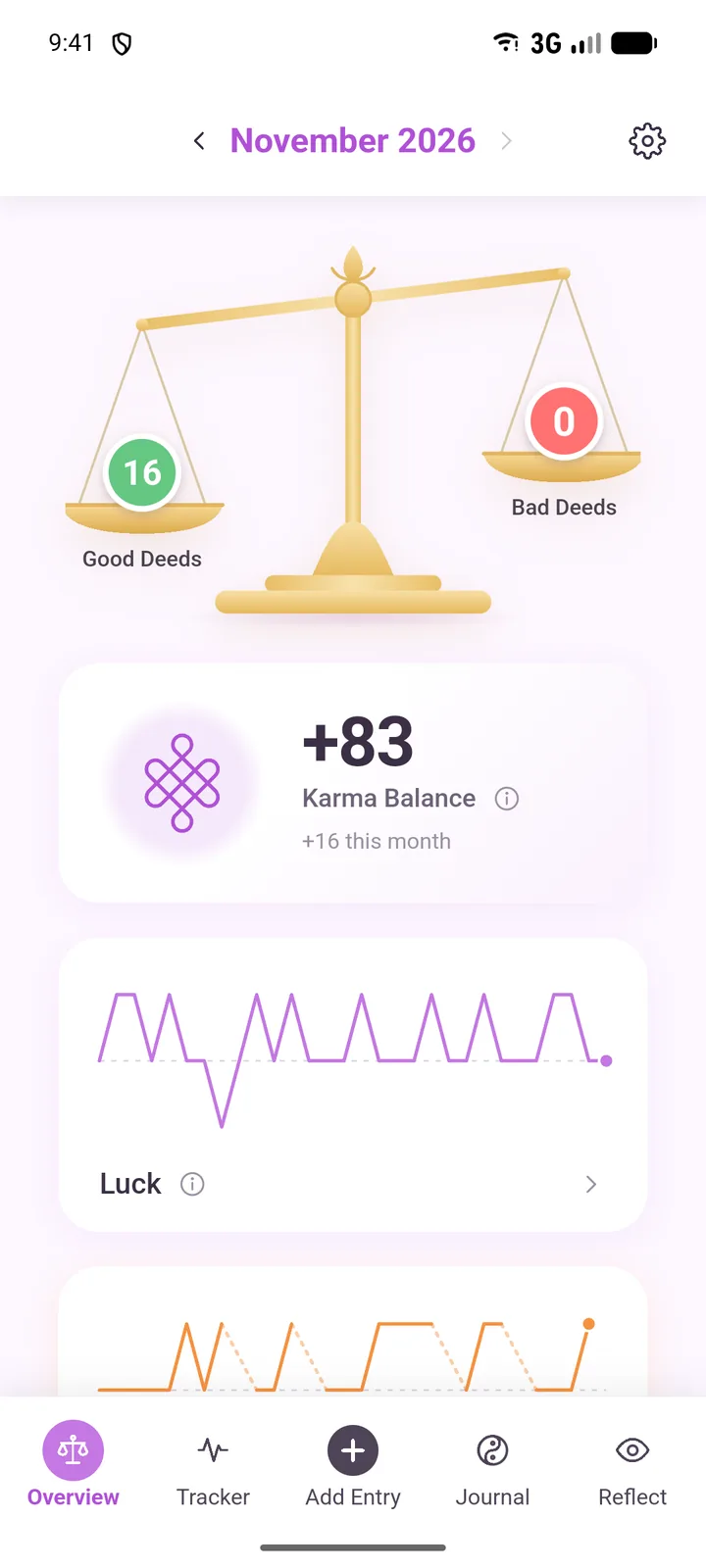
- Karma Balance: good deeds minus the not-so-good ones, on a golden balance scale.
- Tracker: your luck and mood as lines, with deeds, prayers, events and gratitude marked underneath, by week, month or year.
- Insights: a month-by-month table of karma, luck and mood, with a few plain-language notes, like when your karma turned and whether your luck followed.